
Cannabis bud trichomes are tiny structures found on cannabis flowers and other parts of the plant. They are frequently discussed in botanical research and cannabis culture because certain trichomes produce resin containing cannabinoids and terpenes. At DANK DISTRICT, this guide explains what trichomes are, how they differ, what they contribute to the plant and why their appearance should not be treated as a reliable measure of potency or safety.
For UK and EU readers interested in cannabis botany, understanding these structures provides a more informed way to interpret descriptions of flower appearance. It also helps separate observable botanical characteristics from marketing language and unsupported claims.
1. What Are Cannabis Bud Trichomes?
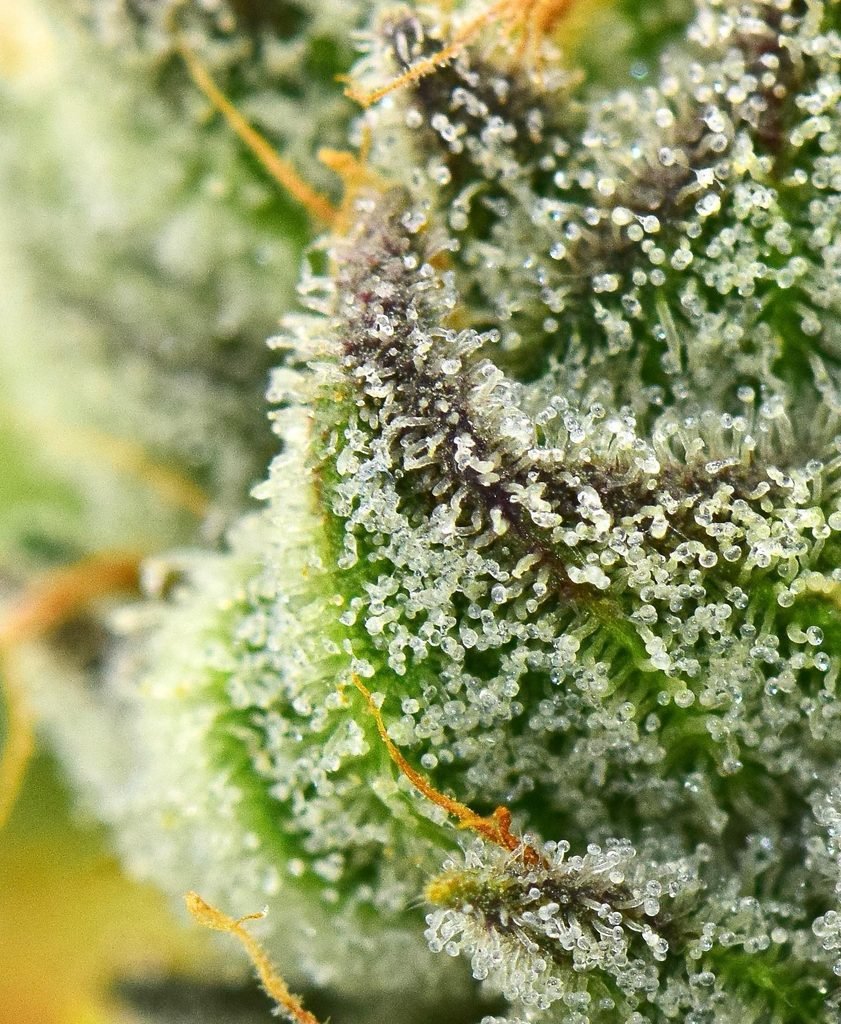
Cannabis bud trichomes are microscopic or near-microscopic structures that grow on the plant’s surface. The word trichome comes from a term meaning hair, although cannabis trichomes can take different forms and are not all simple hairs.
Some trichomes are glandular, meaning they have specialised cells associated with producing or accumulating substances. In cannabis, particular glandular trichomes contain resin in which cannabinoids and terpenes may be found.
Under magnification, some glandular trichomes appear as a stalk topped by a rounded head. Others have different shapes or structures. Their distribution can vary across the plant, and flower surfaces may show a mixture of trichome types.
The visible sparkling appearance often described in cannabis culture is associated with light reflecting from these structures. However, a photograph cannot reliably establish their chemical contents, the concentration of individual cannabinoids or whether the plant material has been tested for contaminants.
2. Different Types of Cannabis Trichomes
Botanical descriptions commonly distinguish between several trichome forms on cannabis plants. These include bulbous, capitate-sessile and capitate-stalked types.
Bulbous trichomes are very small structures that may be difficult to distinguish without suitable magnification.
Capitate-sessile trichomes have a head-like glandular structure without the prominent stalk seen in some other forms.
Capitate-stalked trichomes have a more visible stalk and glandular head. These are often discussed in relation to the resin-producing structures found on cannabis flowers.
The exact appearance and distribution of trichomes depend on the plant and the way specimens are observed. The names describe botanical structures; they are not commercial quality grades.
It is also important to distinguish scientific descriptions from informal terms used in product listings. Words such as “frosty” or “crystal-covered” are visual descriptions rather than standardised laboratory measurements.
3. How Trichomes Relate to Cannabis Resin
Resin is a complex mixture of substances produced or accumulated in particular plant structures. In cannabis, glandular trichomes are important sites associated with the production and storage of cannabinoids and terpenes.
Cannabinoids include compounds such as THC and CBD. Terpenes are a broad group of naturally occurring compounds found in many plants and are associated with characteristic aromas. The composition of cannabis resin can vary according to genetics, environmental conditions and other biological factors.
The presence of visible resin does not reveal the precise proportions of these compounds. Two flowers that look similar may have different chemical profiles, while different-looking flowers may have overlapping profiles.
Reliable characterisation therefore requires more than a visual assessment. Where appropriate, validated laboratory methods can provide measurements of specified compounds. Results should be interpreted alongside information about the sample, testing method and laboratory procedures.
For a related explanation of aroma compounds, read the DANK DISTRICT guide to cannabis terpenes in the UK.
4. Why Trichome Appearance Can Vary
Cannabis trichomes do not look identical on every plant. Their visibility, distribution and apparent colour can vary with genetics, development, environmental conditions, lighting and the condition of the plant material.
A close-up photograph may make structures appear larger or more reflective than they look to the unaided eye. Lighting, focus, image processing and magnification can all influence how a flower appears in an image.
This is one reason photographs should not be treated as proof of chemical composition. A bright, sparkling surface does not establish a specific THC percentage, and the colour of visible trichomes is not a substitute for a laboratory report.
Descriptions should remain specific about what can actually be observed. If a listing claims measured cannabinoid concentrations or laboratory-confirmed results, those claims should be supported by appropriate documentation for the relevant sample or batch.
5. Cannabis Bud Trichomes and Aroma
Cannabis aroma is influenced by a range of volatile compounds, including terpenes. Some of these compounds are associated with familiar descriptive terms such as citrus, pine, floral, herbal or earthy.
Trichomes are relevant to this discussion because glandular structures are associated with compounds that contribute to the plant’s chemical profile. However, aroma cannot identify every compound present, establish its concentration or reliably predict a product’s effects.
Aroma descriptions are best understood as sensory terminology rather than medical or analytical evidence. The same cultivar name does not guarantee an identical aroma profile in every sample.
For readers exploring the subject further, the European Union Drugs Agency provides broader information about cannabis and drug-related research. Scientific findings should be distinguished from informal descriptions used in popular culture.
6. Can Trichomes Prove Cannabis Flower Quality?
No single visible feature can establish overall cannabis flower quality. Trichomes may be an interesting botanical characteristic, but their appearance alone cannot verify potency, purity, freshness, authenticity or freedom from contamination.
A responsible assessment of botanical material may involve several separate considerations:
- Identification: Is the sample accurately described?
- Chemical analysis: Are claimed cannabinoid measurements supported by appropriate testing?
- Contamination testing: Have relevant risks, such as mould or pesticide residues, been assessed where appropriate?
- Traceability: Is there reliable information about the sample’s source and handling?
- Documentation: Do laboratory results clearly identify the tested material and explain the methods used?
A photograph showing numerous visible trichomes cannot answer all these questions. Nor can a product name, strain label or description such as “premium” establish that a sample is safe.
These distinctions are important for anyone reading cannabis-related content online. Clear information should separate visible characteristics, measured chemical properties and claims that have not been independently established.
7. Cannabis Bud Trichomes: UK and EU Information
Cannabis-related terminology is used across research, media and lifestyle communities, but legal requirements differ between jurisdictions. In the UK, cannabis and THC are subject to controlled-drug legislation, with specific exceptions and licensing arrangements. Rules in EU member states vary and should be checked individually.
Botanical information about trichomes does not determine whether a particular cannabis product can legally be possessed, supplied, imported or sold. That question depends on the relevant law and the specific substance or product.
For official UK information, consult the Government’s controlled-drugs licensing guidance. Readers in the EU should consult the relevant national authority alongside European-level research resources.
DANK DISTRICT’s educational approach is to explain cannabis plant structures and terminology without presenting visual features as proof of potency, medical benefit or product safety.
Explore More Cannabis Education at DANK DISTRICT
Cannabis bud trichomes are one part of the wider science of cannabis flowers. Learning about plant anatomy, resin, cannabinoids and terpenes can help readers understand the terminology used in botanical discussions and online descriptions.
Continue with our Cannabis Terpenes UK guide to explore aroma-related terminology, or visit the DANK DISTRICT shop to browse the wider website.
Educational disclaimer: This page provides general botanical information. It does not establish the composition, potency, legality or safety of any particular cannabis sample. Product-specific claims require suitable evidence, and applicable UK or EU laws should always be checked.