
Mycology Reference — Blue Meanie: Identification, Taxonomy and UK & EU Context
The Mycology Reference Blue Meanie guide explores the scientific questions surrounding a mushroom name that can be used ambiguously. For readers in the United Kingdom and European Union, understanding the difference between a common name, a named strain and a verified scientific species is particularly important when researching fungal identification, biodiversity and legal considerations.
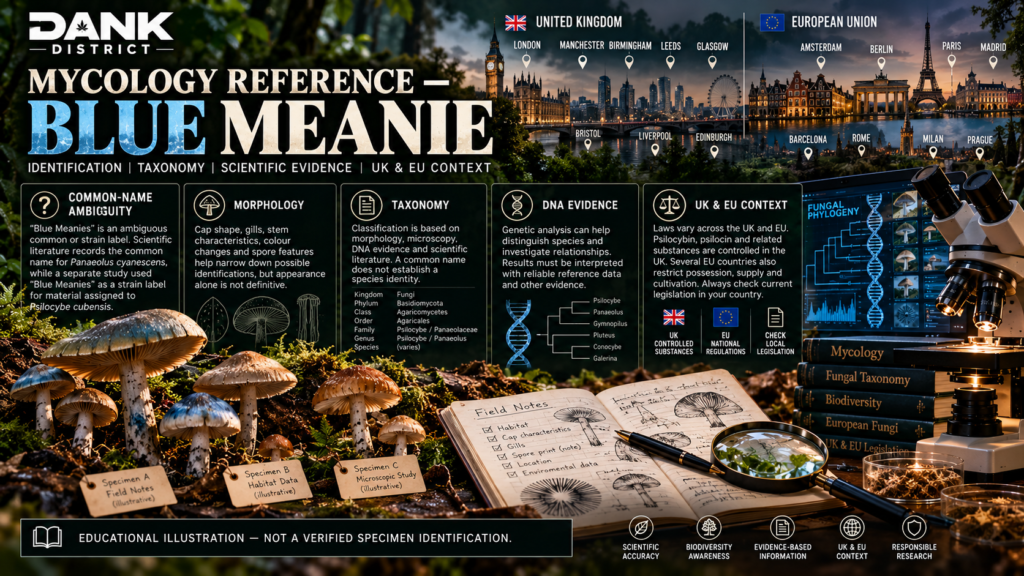
“Blue Meanie” is commonly associated with Panaeolus cyanescens, but the phrase is not an infallible species identifier. Research and specimen records can use informal names differently, so a label alone cannot establish the identity of a particular mushroom. A peer-reviewed review of psychedelic fungal genera discusses the complexity of Panaeolus taxonomy, while research on fungal authentication has documented identification errors in preserved collections.
This Mycology Reference Blue Meanie article provides an educational overview of fungal taxonomy, identification methods, scientific evidence, ecology and the importance of checking local laws. It is designed for readers across London, Manchester, Birmingham, Glasgow, Cardiff and Belfast, as well as European cities such as Amsterdam, Berlin, Paris, Madrid, Rome, Dublin, Brussels and Copenhagen.
The article does not authenticate a product, identify an unknown specimen or provide instructions for cultivating or consuming psychoactive mushrooms.
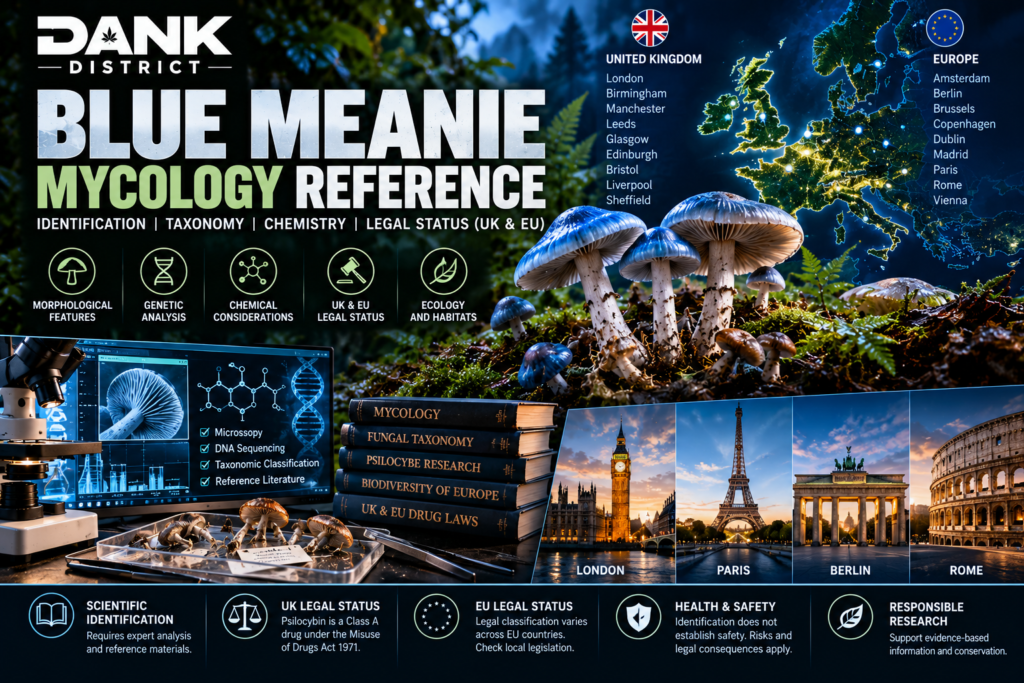
What Does “Blue Meanie” Mean in Mycology?
“Blue Meanie” is a common name rather than a formal taxonomic classification. Common names can develop through local usage, popular culture, commercial labelling and online communities. Their meanings are not always consistent.
The name is often associated with Panaeolus cyanescens. However, a label using “Blue Meanie” should not automatically be interpreted as proof that the material belongs to this species. Informal strain names and common names can be applied inconsistently.
This distinction matters when reading research papers, reviewing photographs or interpreting descriptions published online. A reliable Mycology Reference Blue Meanie article must distinguish documented scientific findings from assumptions based on a familiar name.
Common names and scientific names
Scientific names provide a more precise way to communicate biological identity. In binomial nomenclature, a species is identified using a genus name and a specific epithet.
For example, Panaeolus cyanescens and Psilocybe cyanescens are names from different genera. The shared word “cyanescens” does not mean they are the same species. Likewise, a common name cannot replace a formal scientific identification.
The NCBI Taxonomy database provides a reference record for Psilocybe cubensis, while the Natural History Museum UK species database offers a resource for researching organisms and taxonomic records. Such databases should be interpreted alongside specialist literature and authenticated specimen information.
Understanding Panaeolus cyanescens
Panaeolus cyanescens is a recognised fungal species discussed in scientific literature on fungal diversity, taxonomy and psychoactive compounds. Its classification and distribution have been examined in studies of the genus Panaeolus.
A 2023 peer-reviewed study, Global species diversity and distribution of the psychedelic fungal genus Panaeolus, examines the genus and highlights the challenges involved in understanding its species diversity. The paper explains that taxonomic records can differ between databases and that available molecular data do not cover every named species equally.
These limitations demonstrate why a common name should not be treated as conclusive evidence. Even where the intended species is known, the identity of a particular specimen requires appropriate supporting information.
Why species-level certainty matters
A species-level identification may affect how scientific observations are recorded, how ecological information is interpreted and how findings are compared with other studies. If an organism is misidentified, the error can carry into distribution maps, research databases and later publications.
A Mycology Reference Blue Meanie guide should therefore avoid claiming that a pictured or labelled mushroom is Panaeolus cyanescens unless the identification is supported by appropriate evidence.
How Mycologists Identify Mushrooms
Scientific mushroom identification commonly combines several forms of evidence. No single feature is sufficient for every fungal group.
1. Macroscopic morphology
Macroscopic morphology describes characteristics visible without a microscope. Depending on the organism, researchers may document cap structure, surface texture, gills or other spore-bearing structures, stem features, colour changes and the condition of the specimen.
These observations help researchers compare an unknown specimen with published descriptions. However, visible characteristics can change as a mushroom ages or dries, and unrelated species may share similar appearances.
Photographs can be useful records, but lighting, image quality, missing views and specimen condition may limit their value. Visual similarity should not be confused with a confirmed identification.
2. Microscopy
Microscopy allows specialists to examine smaller structures that are difficult or impossible to assess in ordinary photographs. Relevant features may include spore dimensions and shape, ornamentation, cystidia and tissue structure.
The features that matter vary by genus and species. Reliable identification requires suitable methods, accurate observations and comparison with relevant taxonomic descriptions.
This is particularly important when researchers are distinguishing closely related fungi or assessing material whose original label may be unreliable.
3. DNA analysis
DNA sequencing can help establish relationships between specimens and investigate whether apparently similar fungi represent different evolutionary lineages. Researchers may compare genetic sequences with reference data and combine the results with morphology and specimen records.
However, DNA analysis is not an automatic guarantee of certainty. Results depend on the sample, the genetic region examined, the quality of reference sequences and the reliability of the comparison.
A peer-reviewed paper on DNA authentication and chemical analysis of Psilocybe mushrooms reported misidentifications among preserved fungal specimens and inconsistencies in chemical findings. This demonstrates the importance of reliable authentication and careful interpretation.
A sound Mycology Reference Blue Meanie article should explain that scientific identity requires evidence rather than assumptions based on packaging, common names or photographs.
Why Fungal Taxonomy Changes
Taxonomy is a developing scientific discipline. Researchers revise classifications when new specimens, improved microscopy, DNA evidence or historical analysis provide a clearer understanding of relationships between organisms.
Names may be updated when researchers identify synonyms, reclassify a species or discover that a group contains more diversity than previously recognised. An older scientific paper may therefore use a name that differs from the one preferred in a more recent reference.
This does not automatically make the older research useless. Researchers must understand the name used at the time, examine how it relates to current classifications and assess whether the original identification remains supported.
For further taxonomic research, Index Fungorum and MycoBank provide useful information on fungal names and nomenclature. They are starting points, not substitutes for specialist taxonomic publications or examination of a specimen.
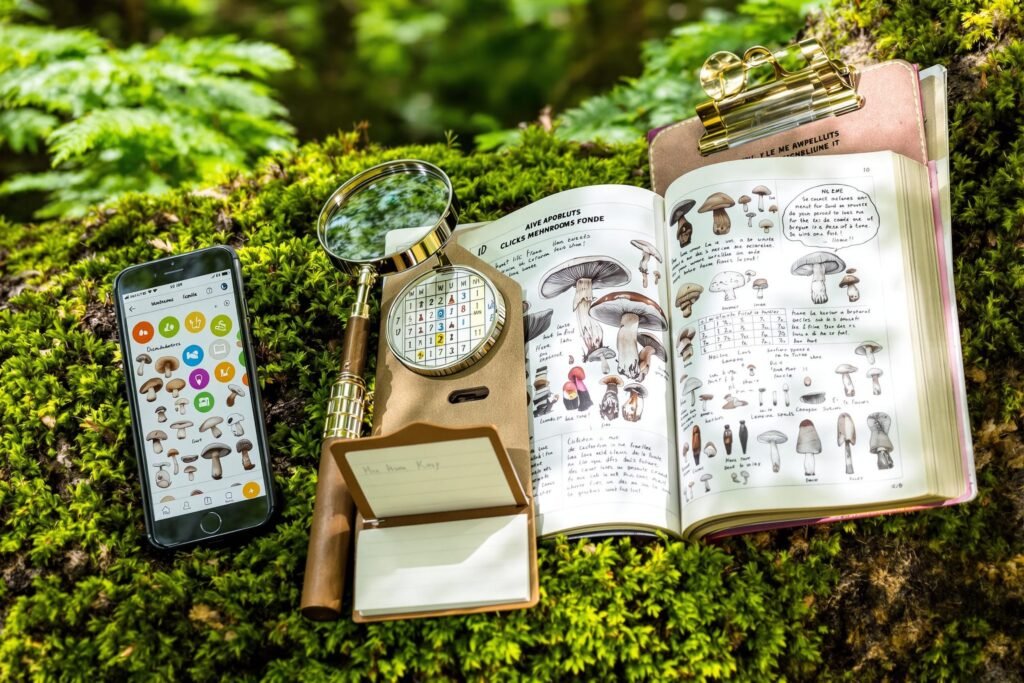
Ecology, Biodiversity and Fungal Habitats
Fungi occupy many ecological roles. Some break down dead organic material, returning nutrients to soil and ecosystems. Others form associations with plant roots, interact with insects or live as parasites and pathogens.
The ecology of a fungus depends on its identity and environmental context. Habitat observations are valuable, but they should not be used as the sole basis for identifying a species.
Why habitat records matter
Researchers may document the location, date, substrate and environmental conditions associated with a specimen. These details help establish where an organism has been recorded and provide context for future comparisons.
A species reported in one region should not automatically be assumed to occur in another. Distribution records can also be influenced by the amount of research conducted in a particular area and the availability of preserved specimens.
For this reason, the Mycology Reference Blue Meanie approach emphasises documented evidence rather than broad claims about where a mushroom supposedly occurs.
UK Context: London, Manchester, Birmingham and Beyond
Readers researching fungal taxonomy in the UK should separate scientific identification from legal interpretation. A mushroom’s name, appearance or claimed origin does not determine its legal status on its own.
The Misuse of Drugs Act 1971 is central to UK controlled-drug legislation. Psilocybin and psilocin are controlled under UK misuse-of-drugs legislation, and relevant activities involving controlled substances can have serious legal consequences.
Legal questions can depend on the precise substance, its form and the activity involved. Readers in London, Manchester, Birmingham, Liverpool, Leeds, Bristol, Sheffield, Glasgow, Edinburgh, Cardiff and Belfast should consult current official legislation rather than rely on online product descriptions or informal discussions.
The UK Government’s controlled drugs list is a useful official starting point. This article provides general educational information, not legal advice about a specific product or situation.
European Union Context: Amsterdam, Berlin, Paris and Other Cities
The European Union does not have one simple, uniform rule covering every issue related to psychoactive mushrooms. National laws and the legal treatment of particular substances can differ between member states.
Readers in Amsterdam, Rotterdam, Berlin, Hamburg, Paris, Lyon, Madrid, Barcelona, Rome, Milan, Brussels, Antwerp, Copenhagen, Stockholm, Vienna and Lisbon should check the current law applicable in the relevant country.
A legal position in one country should not be assumed to apply in another. Nor should a product’s online availability be interpreted as proof that possession, supply, importation or other activity is lawful.
When researching a particular mushroom or compound, check official national legislation and government guidance. The European Union Drugs Agency provides broader information about psychoactive substances and drug-related developments through its official website.
This Mycology Reference Blue Meanie guide does not provide country-by-country legal advice. Rules can change, and the legal position depends on the specific substance and circumstances.
Health and Identification Limitations
Identifying a mushroom and determining whether it is safe are separate tasks. A correct taxonomic name does not automatically establish that a specimen is safe to eat or handle.
Some poisonous fungi can resemble other species, and a common name does not establish chemical composition. Unverified material may also be incorrectly labelled or contain unexpected substances.
This article does not provide consumption, preparation, cultivation or dosing instructions. Anyone who suspects mushroom poisoning should seek urgent medical advice through the appropriate local emergency or poison-information service rather than waiting for an online identification.
A Mycology Reference Blue Meanie article should make these limits clear and avoid presenting an educational overview as a substitute for professional assessment.
How to Evaluate Online Mushroom Information
When reviewing websites, social media posts or product descriptions, readers should ask several questions:
- Is the organism identified by a scientific name, or only a common name?
- Does the source explain how the identification was established?
- Is the information supported by a peer-reviewed publication or authenticated specimen?
- Are claims about geographical distribution supported by records?
- Does the article distinguish scientific findings from assumptions?
- Are legal statements supported by current official sources?
Repeated claims do not become reliable evidence merely because many websites copy them. A stronger source identifies its references, explains uncertainty and corrects errors when new evidence becomes available.
For more educational material, explore the DANK DISTRICT homepage, our Costa Rican Mushroom Taxonomy guide, the B Mushroom Mycology Reference and the Cambodian Strain Mycology Reference. Each article covers a separate topic and should not be treated as proof of a particular specimen’s identity.
Frequently Asked Questions
What does Blue Meanie mean?
Blue Meanie is a common name often associated with Panaeolus cyanescens, but common-name usage can vary. The name alone does not authenticate an unknown mushroom.
Is Blue Meanie a formal scientific species name?
No. It is a common name. Formal identification requires a scientific name supported by appropriate evidence, and the intended meaning of a common name should be checked in context.
Can a photograph confirm a Blue Meanie identification?
A photograph can document visible characteristics but may not show the features required for reliable species-level identification. Specialist examination and other evidence may be necessary.
Is the legal position the same across the UK and EU?
No single summary covers every jurisdiction and circumstance. UK legislation and national laws across Europe should be checked separately, using current official sources.
Does DNA testing always provide a definitive answer?
No. DNA analysis is a valuable tool, but results depend on sample quality, reference data and interpretation. Researchers often combine molecular evidence with morphology and documented specimens.
Does this article verify a particular mushroom product?
No. This Mycology Reference Blue Meanie article is educational and does not authenticate a product, identify an individual specimen or confirm its chemical contents.
Conclusion: Mycology Reference Blue Meanie
The Mycology Reference Blue Meanie guide demonstrates why common names, scientific classifications and verified specimen identities must be kept separate. Although “Blue Meanie” is often associated with Panaeolus cyanescens, the label alone is not sufficient to confirm the identity of any particular mushroom.
Reliable mycology combines morphology, microscopy, DNA analysis, taxonomic literature and documented specimen records. Research on fungal authentication also shows why identification errors can occur, making evidence and transparent reporting essential.
For readers across the UK and EU, scientific research should be considered separately from local legal requirements. Whether researching the subject in London, Glasgow, Amsterdam, Berlin, Paris, Madrid or Rome, use reputable scientific sources and check the applicable national laws.
Explore the related DANK DISTRICT references linked throughout this article for further educational context. Each fungal topic should be assessed individually, without assuming that a shared common name establishes identical taxonomy, chemistry, safety or legal status.
Editorial disclaimer: This article is for general educational purposes only. It is not a product verification, medical recommendation, identification service or guide to cultivating or consuming psychoactive mushrooms.
Mycology Reference Blue Meanie
The Mycology Reference Blue Meanie provides an educational overview of mushroom identification, fungal taxonomy and scientific evidence. A reliable Mycology Reference Blue Meanie should distinguish common names from verified scientific identities and avoid unsupported claims about individual specimens.
This Mycology Reference Blue Meanie also highlights the importance of morphology, microscopy, DNA analysis and reliable scientific literature. A familiar name or photograph alone cannot confirm a mushroom’s species, origin or chemical composition.
Readers in London, Manchester, Birmingham and Glasgow, as well as Amsterdam, Berlin, Paris and Madrid, can use reputable scientific publications and recognised fungal databases to explore mycology further. Always distinguish scientific research from assumptions about a particular mushroom.
Ultimately, the Mycology Reference Blue Meanie is intended to encourage accurate identification, responsible reporting and evidence-based research. Taxonomic classifications can change as new findings emerge, so information should be checked against current scientific sources.
For further reading, explore the DANK DISTRICT homepage, the Costa Rican Mushroom Taxonomy guide and the B Mushroom Mycology Reference.