
Triple Filtered CBD Hash: Product Guide, Filtration Claims, Lab Testing and UK/EU Rules
Triple Filtered CBD Hash is the focus of this DANK DISTRICT guide to product descriptions, filtration terminology, cannabinoid information, laboratory testing and UK/EU considerations. The goal is to help readers understand what “triple filtered” may communicate, which claims require evidence, and how to assess the information supplied for a specific product.
The phrase “triple filtered” suggests a filtration process involving three stages or passes. However, the name alone does not confirm the precise production method, the material used, the CBD concentration, or the final product’s purity. Those details should be supported by the supplier’s specifications and relevant documentation.
For the current item, visit the Triple Filtered CBD Hash product listing at DANK DISTRICT. Use that live page as the reference for the product details currently available, rather than assuming that every product sold under a similar name has the same characteristics.
DANK DISTRICT’s editorial approach is premium presentation backed by clear information: explain the terminology, distinguish supplier claims from verified results, and avoid making technical or legal promises that cannot be established.
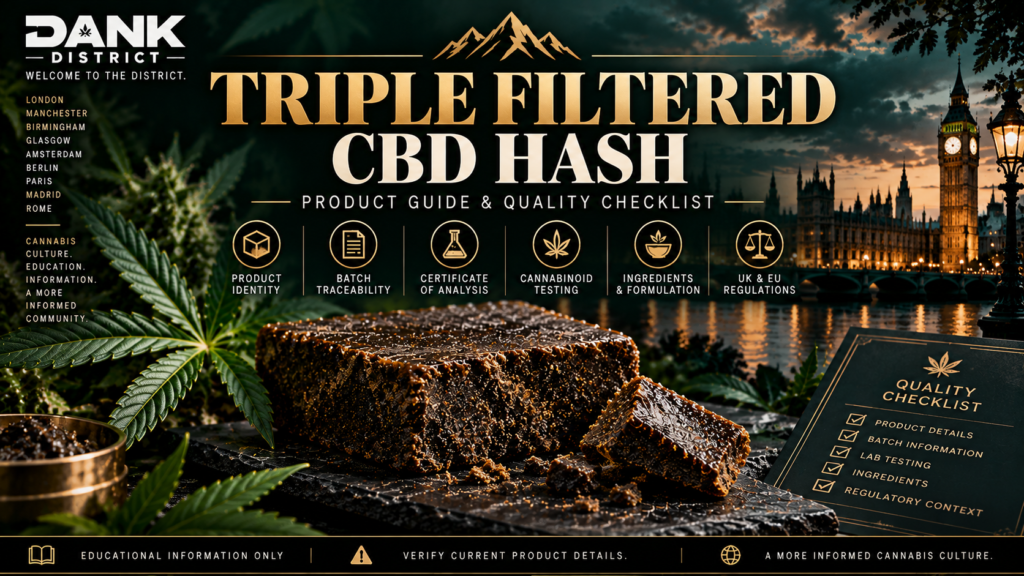
What Is Triple Filtered CBD Hash?
Triple Filtered CBD Hash is a product name that combines a CBD-focused hash-style category with a description of filtration. In general language, filtration means passing material through a filtering medium to separate certain components. The actual process, however, depends on the material and production system involved.
The phrase “triple filtered” may suggest repeated filtration, but it is not a universally defined quality grade. Without a clear manufacturing description, it does not tell a reader which filters were used, what each stage was designed to remove, or how the final product was assessed.
For Triple Filtered CBD Hash, it is important to separate three different types of information:
- Product identity: The name, packaging, weight and description used by the seller.
- Process claims: Statements about filtration, refinement, ingredients or production.
- Verified product specifications: Evidence such as relevant laboratory results and traceable batch documentation.
A product name can help identify an item in a catalogue, but it cannot independently prove a particular filtration process or laboratory-confirmed purity.
Start with the Triple Filtered CBD Hash listing to check the current product description and determine which claims are actually stated.
What Does “Triple Filtered” Mean?
In its broadest sense, filtration is a process used to separate material according to the properties of the filtering system. In botanical and resin-related products, processing terms may refer to different methods, stages or materials depending on the producer.
The important distinction is that three filtration stages do not automatically establish three times the purity or a superior cannabinoid profile. Results depend on the process, the material being filtered, the contaminants or particles targeted, and the way the finished product is tested.
Filtration claims need context
When a product is described as triple filtered, useful questions include:
- Does the supplier explain what is filtered?
- Are the stages or process described clearly?
- Is the terminology being used consistently?
- Does the supplier explain which characteristics the process is intended to affect?
- Is any final-product claim supported by appropriate testing?
A detailed answer may not be provided on every product page. If the production method is not specified, it is more accurate to treat “triple filtered” as part of the product’s name or marketing description rather than as a verified technical standard.
Filtration is not the same as laboratory testing
Filtration describes a process; laboratory testing measures specified characteristics of a sample. These serve different purposes.
A process description cannot replace a cannabinoid analysis, and a cannabinoid analysis cannot automatically verify every step in a manufacturing process. The evidence needed depends on the particular claim.
For Triple Filtered CBD Hash, avoid assuming that the filtration description proves the absence of contaminants, a particular CBD percentage or a specific THC level. Those claims need their own appropriate evidence.

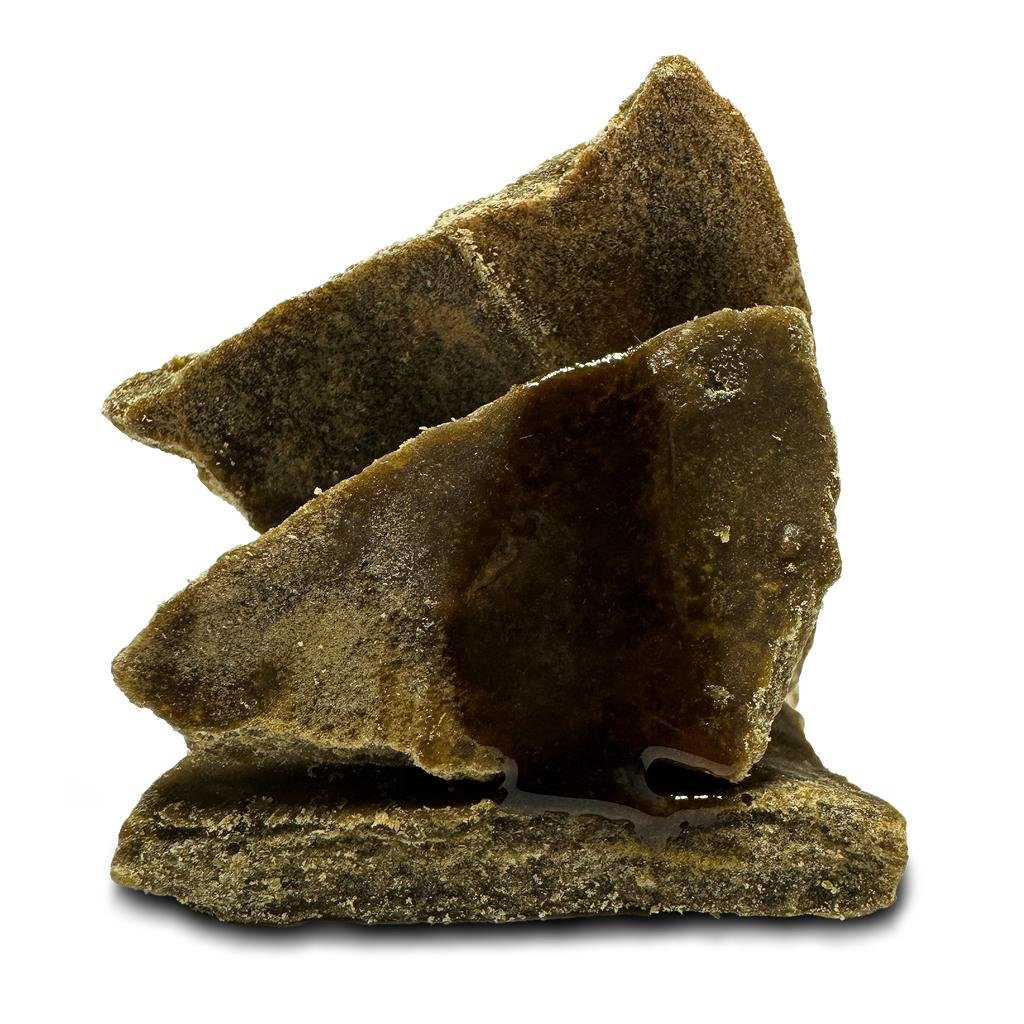
Triple Filtered CBD Hash: Appearance and Product Description
Hash-style products are commonly described in terms of colour, texture, consistency and overall presentation. Such descriptions can help readers understand how a seller presents an item, but they do not independently establish its composition.
A dark appearance, glossy surface, compact form or soft texture should not be treated as proof of a specific filtration method. Photographs can also vary with lighting, camera settings, image editing and the surface on which the product is shown.
When reviewing Triple Filtered CBD Hash, use the actual product listing and its images to establish the appearance being represented. If the supplier makes a claim about texture, ingredients or processing, check whether that claim is explained in the product information.
What should a clear listing include?
Where applicable, useful product information includes:
- The full product name and net weight.
- Ingredients or formulation details.
- A stated CBD concentration and clear units.
- THC and other relevant cannabinoid results, where available.
- Batch or lot identification.
- Supplier information and traceability details.
- Relevant warnings and storage information.
- Supporting documentation, if supplied.
Not every product will provide every detail in the same format. The important point is to distinguish what the seller states from what has been independently verified.
For the current product details, consult the DANK DISTRICT Triple Filtered CBD Hash page.
CBD and THC: Understanding the Cannabinoid Profile
CBD, short for cannabidiol, is one of the cannabinoids associated with cannabis and hemp. THC is a different cannabinoid and is subject to specific legal controls in the UK.
The phrase Triple Filtered CBD Hash does not establish the actual CBD concentration or confirm that THC and other controlled cannabinoids are absent. These questions require suitable evidence about the specific product.
How to review cannabinoid results
If a certificate of analysis (COA) is available, review the document rather than relying only on a badge or marketing statement.
Look for the following:
- CBD concentration: Is the reported amount clear, and are the units identified?
- THC results: Are relevant THC measurements reported, including any applicable reporting limits?
- Sample identity: Does the report identify the sample that was tested?
- Batch reference: Does the documentation match the product batch where applicable?
- Laboratory details: Is the laboratory identifiable, and is the method appropriate for the stated analysis?
- Testing date: Is the report relevant to the current product?
- Scope of testing: Does the document explain which substances or characteristics were examined?
A COA only provides evidence within the scope of the analysis it reports. A cannabinoid profile does not automatically establish that the sample was tested for every potential contaminant.
Likewise, a report for one batch should not automatically be treated as verification for another. A result below a laboratory’s reporting or quantification limit also needs to be interpreted according to the report’s stated method and limitations.
The UK Home Office provides relevant background in its factsheet on cannabis, CBD and other cannabinoids.
A Practical Quality Checklist for Triple Filtered CBD Hash
Product quality cannot be established by a premium-looking label, a filtration claim or an attractive photograph alone. A more useful assessment starts with identity, traceability, documented specifications and the scope of any available testing.
1. Verify the product identity
Check that the product name, net weight, description and any listed variations match the item being represented. If several sizes or formulations are offered, confirm that the specifications apply to the correct version.
The Triple Filtered CBD Hash product page is the primary reference for the current DANK DISTRICT listing.
2. Understand the filtration claim
Look for an explanation of what “triple filtered” means in the supplier’s context. If the process is not described, do not assume that the phrase represents an industry-wide certification or a standardised purity grade.
3. Review the ingredients
Check the ingredient or formulation information where applicable. Avoid assuming that a product is additive-free or made entirely from a particular source simply because its name or branding suggests it.
4. Match the batch to the documentation
If a batch or lot number is provided, compare it with the relevant certificate or product record. Documentation should refer to the sample or batch being represented.
5. Check the testing scope
Find out what was actually measured. Cannabinoid testing, contaminant analysis and verification of a production method are different forms of assessment. A single report should not be assumed to cover all of them.
6. Check supplier traceability
Look for an identifiable supplier and a suitable contact route for questions. If an important specification is missing or unclear, ask for clarification instead of assuming the answer.
7. Be cautious with absolute claims
Statements such as “pure,” “THC-free,” “fully compliant” or “laboratory certified” should be supported by appropriate evidence and interpreted in context. A filtration claim alone does not prove any of these statements.
This checklist helps readers evaluate Triple Filtered CBD Hash using evidence rather than relying solely on product naming or marketing language.
UK Regulations: CBD Products and Controlled Cannabinoids
The legal treatment of a CBD-labelled product depends on its composition, classification, intended use and the legal framework that applies. It cannot be established simply by finding the letters “CBD” on a product page.
The Home Office explains that pure CBD is not itself controlled under the Misuse of Drugs Act 1971, while certain other cannabinoids, including THC, are controlled. Preparations containing controlled substances can raise separate legal questions, subject to the applicable rules and exemptions.
For more information, consult the official Home Office factsheet on cannabis, CBD and other cannabinoids.
There is also a distinct regulatory framework for CBD products sold as food. The Food Standards Agency’s CBD guidance, updated in August 2026, explains the novel-food status of CBD extracts, isolates and associated products in the relevant UK framework. Products in this category may require authorisation before they can legally be marketed as food.
These are separate regulatory questions. Controlled-drug status, food-law requirements, medicines regulation and other product requirements should not be treated as interchangeable.
Accordingly, this guide does not declare Triple Filtered CBD Hash automatically legal or compliant. The specific product, its formulation, its intended category and the applicable rules must be assessed before making that determination.
UK and European Market Considerations
CBD and hemp-related rules can differ between countries and product categories. Readers in London, Manchester, Birmingham, Bristol, Glasgow and Edinburgh should check the requirements that apply to their location and the actual product.
European readers should take the same careful approach. A product’s status in Amsterdam does not automatically establish its status in Berlin, Paris, Madrid or Rome. National requirements, product classifications, controlled-cannabinoid rules and import restrictions may differ.
Cross-border shipping introduces further questions. The fact that a product appears on an online catalogue does not prove that it can be lawfully sold, imported, possessed or transported to every destination.
Before making decisions involving Triple Filtered CBD Hash, confirm the current product specifications and consult the official guidance relevant to the destination jurisdiction. Avoid assuming that one country’s rules apply throughout the UK or Europe.
Responsible Product Information at DANK DISTRICT
Good product information should help readers identify what is being described, understand the seller’s claims and recognise which details remain unverified.
For Triple Filtered CBD Hash, the current DANK DISTRICT product listing is the starting point for checking the specifications currently available. If the listing does not explain the filtration method, state a cannabinoid concentration or provide relevant documentation, those details should not be invented.
Medical claims also require care. The UK Medicines and Healthcare products Regulatory Agency states that products containing CBD marketed for medical purposes can fall within medicines regulation and require the appropriate authorisation unless an exemption applies. See the MHRA statement on products containing CBD.
This article is educational. It does not certify the composition or safety of a particular product, provide legal advice or recommend CBD as a treatment for any medical condition.
Frequently Asked Questions About Triple Filtered CBD Hash
What is Triple Filtered CBD Hash?
Triple Filtered CBD Hash is a product name combining a CBD-focused hash-style category with a description suggesting repeated filtration. The exact ingredients, production method and cannabinoid profile must be confirmed from the current product listing and relevant supporting documentation.
Does “triple filtered” guarantee higher purity?
No. The phrase does not, by itself, establish a standardised purity grade or prove that a product is free from contaminants. The meaning depends on the supplier’s process, and product-specific claims should be supported by suitable evidence.
Does Triple Filtered CBD Hash contain THC?
The product name alone cannot establish whether THC is present or at what concentration. Check relevant analytical results and confirm that any report relates to the specific product or batch. A CBD label should not be treated as proof that a product is THC-free.
How can I verify the CBD concentration?
Look for a clearly stated CBD concentration with appropriate units. If a COA is available, check the sample identity, testing date, laboratory details and scope of analysis. Do not estimate the concentration from the product name or from a similar listing.
Does filtration replace laboratory testing?
No. Filtration is a processing term, while laboratory testing measures specified characteristics of a sample. Neither automatically proves every claim that might be made about the final product.
Is Triple Filtered CBD Hash legal in the UK?
That cannot be determined from the product name alone. Composition, classification and applicable legal requirements matter. Consult current official guidance and obtain qualified advice if the status of a specific product is uncertain.
Are CBD products regulated the same way throughout Europe?
No single assumption should be applied to every country and product category. National rules and import requirements may differ. Check the relevant official guidance for the destination jurisdiction before purchasing or transporting a product.
Where can I find the current product details?
Visit the Triple Filtered CBD Hash product page at DANK DISTRICT and review the current listing. If a specification is missing or unclear, ask the supplier rather than relying on assumptions.
Conclusion: Look Beyond the Filtration Claim
Triple Filtered CBD Hash has a distinctive name within the wider CBD and cannabis-culture market, but the words “triple filtered” are not a substitute for verified product information.
A more informed assessment begins with the current listing, a clear understanding of the supplier’s terminology, traceable product details and relevant laboratory documentation where available. It also means recognising that a filtration claim cannot independently establish purity, cannabinoid concentration or legal status.
For readers across the UK and Europe, the priority is evidence rather than assumptions. Review the current Triple Filtered CBD Hash listing at DANK DISTRICT for the specifications currently available.
DANK DISTRICT — WELCOME TO THE DISTRICT.
Educational information only. This article is not medical or legal advice and does not certify the composition, safety or legality of any specific product.