
Albino Penis Envy Psilocybe Cubensis: Mycology Reference and Scientific Evidence
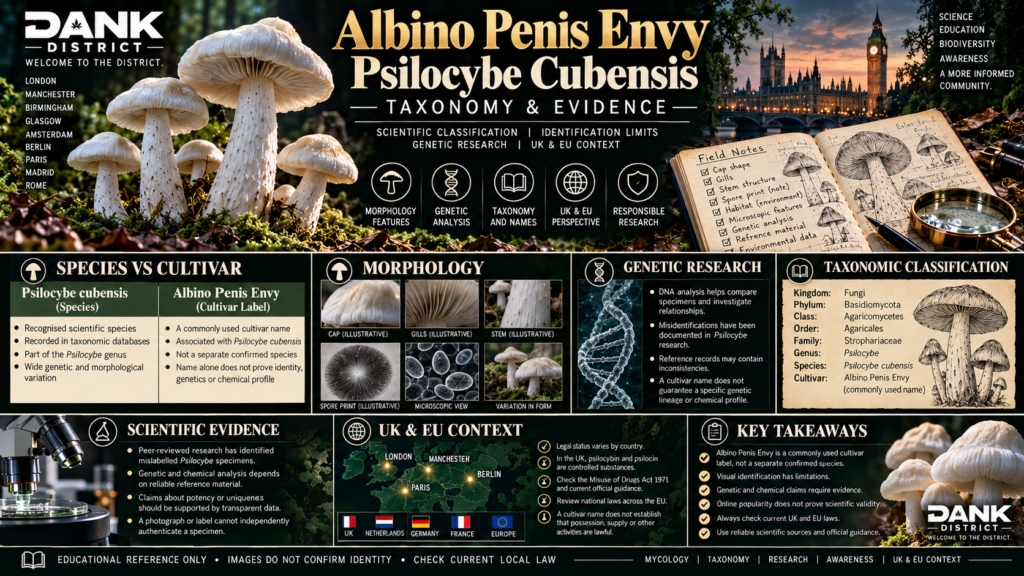
Albino Penis Envy Psilocybe Cubensis is a commonly used cultivar name associated with Psilocybe cubensis. It is frequently discussed in online mushroom communities because of its distinctive name and descriptions of pale or white appearance. However, popularity and appearance do not independently establish the identity, genetic history or chemical characteristics of a specimen. A reliable mycology reference must separate informal naming from scientific classification and distinguish documented research from claims that remain uncertain.
This guide examines Albino Penis Envy through taxonomy, cultivar terminology, morphology, genetic research, scientific evidence and UK/EU context. Readers in London, Manchester, Birmingham, Glasgow, Amsterdam, Berlin and Paris can use the same evidence-based principles when assessing online information: a familiar label is not proof of biological identity.
For the dedicated DANK DISTRICT page, visit the Albino Penis Envy Psilocybe Cubensis reference. The page should be understood in the context of the scientific distinctions explained throughout this article.
What Is Albino Penis Envy Psilocybe Cubensis?
The phrase Albino Penis Envy Psilocybe Cubensis combines a commonly used cultivar label with the scientific species name Psilocybe cubensis. Understanding this distinction is the starting point for evaluating claims about the name.
Psilocybe cubensis is a recognised fungal species recorded in scientific taxonomic resources. The NCBI Taxonomy Browser provides a useful starting point for its classification, although NCBI notes that its database is not the final authority on fungal nomenclature.
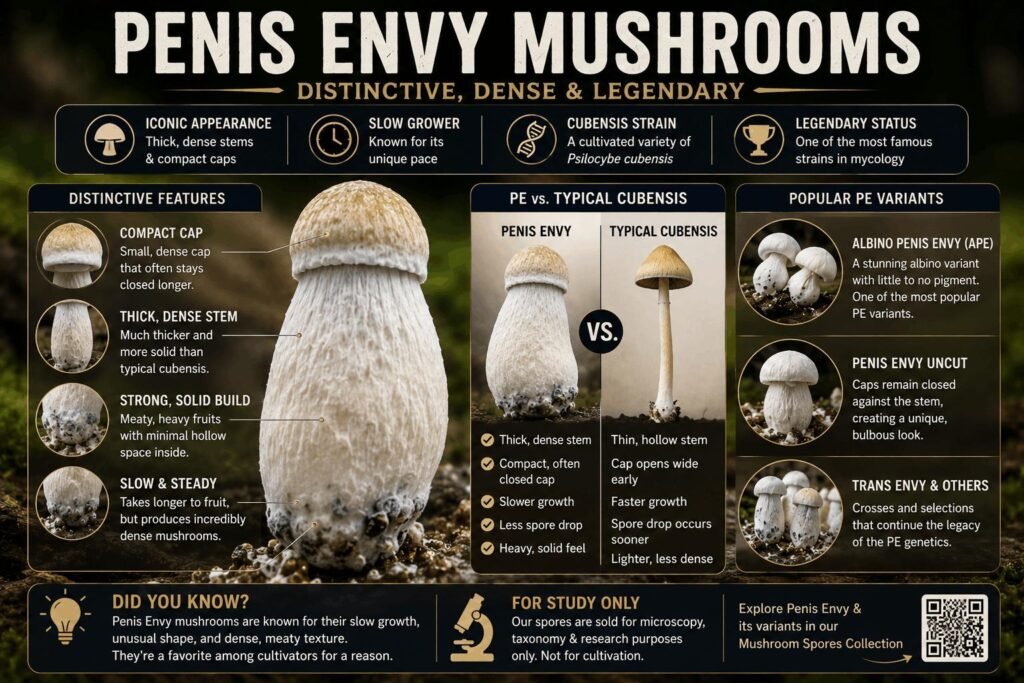
Albino Penis Envy, by contrast, is a cultivar label used in discussions of cultivated material associated with that species. The label is not, by itself, evidence of a separately recognised species or a scientifically authenticated lineage. Different sources may use the same name without demonstrating that the material they describe has a shared, independently verified history.
The word “albino” is often used in informal cultivar naming to describe a pale appearance. That description should not be treated as proof of a specific genetic mechanism. Establishing the biological basis of a particular trait requires appropriate evidence rather than an inference from colour or a product label.
For more context, the Albino Penis Envy Psilocybe Cubensis page can be read alongside recognised taxonomic resources and peer-reviewed research. Neither the page title nor the label alone authenticates an individual specimen.
Understanding Taxonomy and Cultivar Names
Taxonomy is the scientific practice of naming, describing and classifying organisms. It provides a shared framework for researchers and helps prevent confusion when common names vary between locations or communities.
Three terms matter when discussing Albino Penis Envy Psilocybe Cubensis:
- Genus: Psilocybe, the broader group.
- Species: Psilocybe cubensis, the scientific species name.
- Cultivar label: Albino Penis Envy, a commonly used name for cultivated material associated with the species.
These terms describe different things. A cultivar label does not automatically establish a formal taxonomic category, prove a distinct genetic group or guarantee that every specimen carrying the name shares the same characteristics.
The history of informal cultivar names can also be difficult to reconstruct. A name may be repeated across forums, articles and listings without a traceable original record or independent scientific confirmation. Multiple sources repeating a claim do not necessarily provide multiple independent pieces of evidence.
A careful Albino Penis Envy Psilocybe Cubensis reference therefore avoids presenting an unverified origin story as settled science. Where the evidence is incomplete, that uncertainty should be stated clearly.
The distinction between species and cultivar is useful well beyond this example. Many cultivated organisms have names that communicate a history, appearance or community convention without replacing formal scientific classification. Mycology requires the same care with terminology as other biological disciplines.
Morphology: What Appearance Can Tell Us
Morphology is the study of an organism’s physical form and structure. In fungal research, specialists may examine features such as cap shape, gill structure, stem characteristics, spore morphology and microscopic traits when assessing a specimen.
Appearance can provide useful information, but it has limits. Features may overlap among related fungi, and the appearance of an individual specimen can be affected by age, environmental conditions, preservation, lighting and image quality. Photographs can also omit details needed for a rigorous assessment.
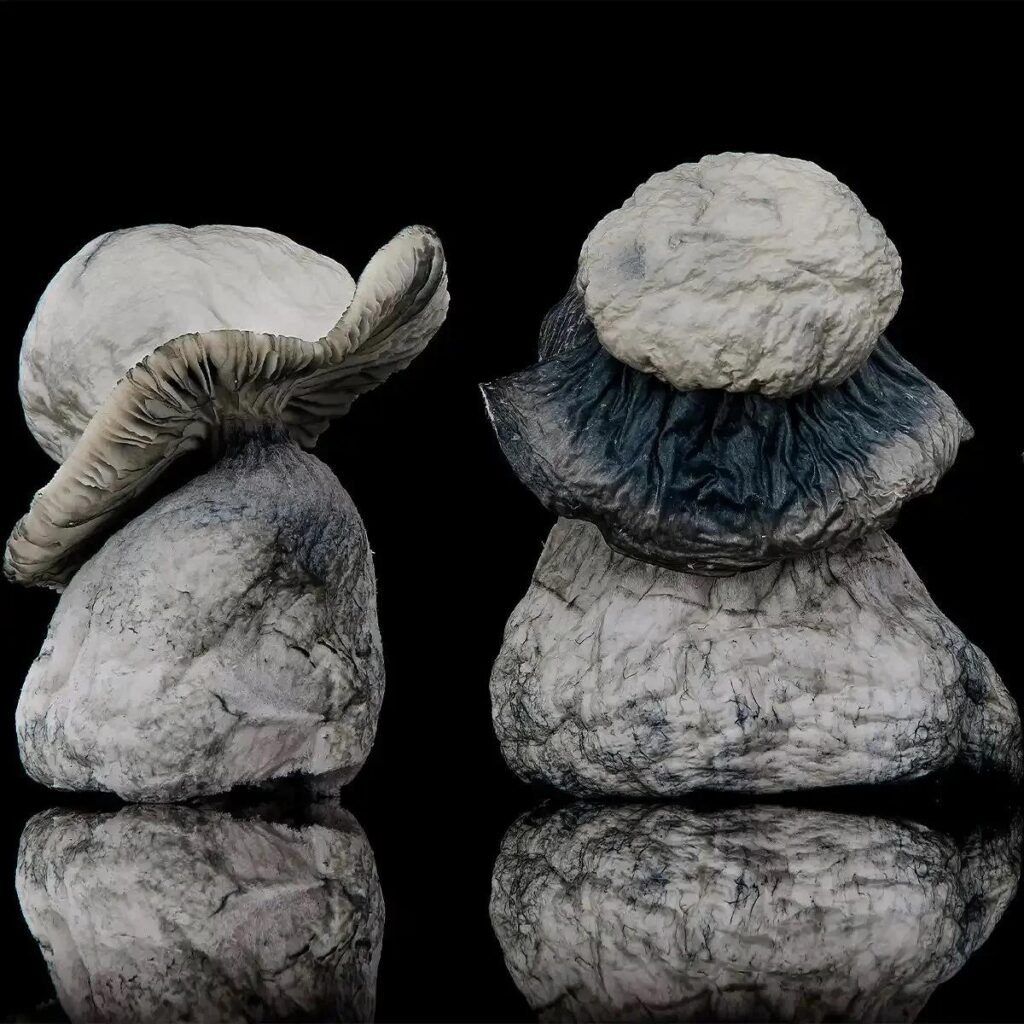
A pale or white appearance does not independently confirm the Albino Penis Envy label. Nor can a photograph establish genetic lineage or chemical composition. Even when an image resembles a published description, resemblance is not equivalent to authentication.
The European Union Drugs Agency explains that hallucinogenic mushrooms can be difficult to distinguish from other fungi using visual observation alone. See its hallucinogenic mushrooms drug profile for further context on identification challenges.
Images accompanying this article are editorial illustrations. They are not authenticated specimen photographs and should not be used to identify mushrooms found in the wild or purchased from an online source.
Genetic Research and Identification Limits
DNA analysis can help researchers investigate fungal relationships, assess species classifications and compare specimens with reference material. Genetic evidence is particularly valuable when visible features do not provide a clear distinction.
However, DNA analysis is not automatically conclusive. Results depend on sample quality, analytical methods, the provenance of the specimen and the reliability of the reference sequences used for comparison. A sequence associated with a misidentified sample can also affect later research if its label is accepted without scrutiny.
A peer-reviewed study published in Applied and Environmental Microbiology examined DNA authentication and chemical analysis in Psilocybe mushrooms. The researchers reported widespread misidentifications among the fungarium specimens they examined and problems involving some public sequence records. Their findings demonstrate why reliable reference material and careful documentation are essential.
Read the study: DNA Authentication and Chemical Analysis of Psilocybe Mushrooms.
The study does not authenticate or invalidate every specimen carrying the Albino Penis Envy name. Rather, it highlights broader scientific limitations that should inform how claims about fungal identity are evaluated.
A strong Albino Penis Envy Psilocybe Cubensis reference distinguishes between what a study directly investigated and what can reasonably be concluded from it. Evidence about Psilocybe identification generally should not be misrepresented as a specific genetic finding about a cultivar that the study did not independently test.
Chemical Claims and the Importance of Evidence
Online descriptions of named cultivars sometimes make confident claims about chemical composition, potency or consistency. Such claims need suitable analytical evidence before they can be treated as established facts.
A cultivar name is not a laboratory result. It cannot establish a precise chemical profile, guarantee consistency between specimens or demonstrate that independently sourced material is equivalent. Findings from one sample should not automatically be generalised to all material described with the same label.
The research cited above also illustrates that chemical findings can depend on the specimen, its condition, the analytical method and the quality of its identification. Scientists must account for these variables before drawing conclusions.
When reading claims about Albino Penis Envy Psilocybe Cubensis, it helps to separate information into three categories:
- Documented findings: results supported by reliable research or recognised scientific records.
- Reported observations: claims that a source describes but that may not have been independently verified.
- Unverified assertions: statements presented without enough evidence to assess their accuracy.
This approach avoids turning informal descriptions into scientific conclusions. It also helps readers recognise the difference between a statement about a cultivar’s reputation and a finding demonstrated through appropriate analysis.
Albino Penis Envy in Online Culture and Mycology Education
The visibility of Albino Penis Envy reflects a broader pattern in which cultivar names spread through online communities and popular discussions. Familiar names can become widely recognised even when documentation of their origins or genetic distinctiveness remains incomplete.
Different sources serve different purposes. A scientific paper explains methods and findings; a taxonomic database organises organism names; a forum may collect individual observations; and a commercial page may use a name to describe its offering. These sources should not be treated as interchangeable.
For readers in London, Manchester, Birmingham and Glasgow, or across Amsterdam, Berlin and Paris, the same standards apply. Local popularity, online attention and repeated descriptions do not independently verify a specimen’s identity.
DANK DISTRICT’s educational content aims to help readers understand these distinctions. The Albino Penis Envy Psilocybe Cubensis reference is part of the site’s wider discussion of fungal terminology and evidence quality. Readers can also explore the Golden Teacher Mushroom Strain reference for a related explanation of the difference between a species name and a cultivar label.
These links provide related educational reading; they are not independent scientific verification of any particular specimen or third-party claim.
UK and European Legal Context
Scientific classification and legal status are separate matters. A cultivar name does not determine whether an activity involving a particular fungus is lawful. Legal rules may address controlled substances, organisms containing those substances, possession, supply, importation and activities undertaken for authorised research.
In the UK, psilocybin and psilocin are controlled substances, and activities involving mushrooms containing controlled substances can raise legal issues. The Misuse of Drugs Act 1971 is an official starting point for reviewing the legislation. Readers should check current legislation, relevant amendments and official guidance for their circumstances.
Across Europe, the details of national legal frameworks can differ. The European Union Drugs Agency’s hallucinogenic mushrooms profile offers background information, but a reader should consult current official sources in the relevant country for a specific legal question.
Whether researching the topic in the UK, the Netherlands, Germany, France or elsewhere in Europe, do not assume that a product label establishes legality. This article is general educational information and is not legal advice.
How to Evaluate Online Mycology Claims
A reliable reference explains what is known, identifies what remains uncertain and directs readers towards sources they can evaluate independently. This is especially important when the same claim appears across many websites.
When assessing information about Albino Penis Envy Psilocybe Cubensis, consider these questions:
- Does the source clearly distinguish the species name from the cultivar label?
- Does it cite scientific literature or an identifiable reference record?
- Are genetic or chemical claims supported by transparent methods?
- Does it acknowledge uncertainty and limitations?
- Are photographs described accurately as illustrative or authenticated?
- Does the article link to recognised taxonomic resources and peer-reviewed research?
- Are multiple sources independently supporting a claim, or repeating the same original statement?
These questions help readers assess credibility without assuming that every popular claim is correct. They also help identify when an article is providing useful context rather than presenting an unsupported assertion as a fact.
For additional context, revisit the Albino Penis Envy Psilocybe Cubensis article page and compare its subject matter with the external research linked in this guide. The strongest conclusions come from matching each claim to the type and quality of evidence that can support it.
Frequently Asked Questions
Is Albino Penis Envy a separate species?
Albino Penis Envy is commonly used as a cultivar label associated with Psilocybe cubensis. The label itself does not establish a separate, formally recognised species.
Does the word “albino” prove a specific genetic trait?
No. A name or pale appearance alone does not establish the genetic mechanism behind a trait. Such claims require suitable scientific evidence.
Can a photograph confirm the identity of a specimen?
No. Photographs can illustrate visible features, but they cannot independently verify cultivar identity, genetic lineage or chemical composition.
Does the cultivar name guarantee a particular chemical profile?
No. A cultivar label is not a laboratory measurement. Chemical claims require appropriate analysis and should be interpreted within the limits of the evidence.
Is this article a cultivation or consumption guide?
No. This is an educational reference about taxonomy, terminology, scientific evidence and identification limitations. It does not provide cultivation, preparation or consumption instructions.
Where can I find reliable information?
Start with recognised taxonomic resources, peer-reviewed scientific literature and official legal sources. The NCBI taxonomy record, the European Union Drugs Agency profile and the DNA authentication study linked in this article are useful starting points.
Conclusion: Albino Penis Envy Psilocybe Cubensis Mycology Reference
Albino Penis Envy Psilocybe Cubensis is best understood as a commonly used cultivar label associated with Psilocybe cubensis, not as a separate species name established by the label alone. Its popularity and reported appearance do not independently confirm a specimen’s identity, genetic history or chemical properties.
A reliable Albino Penis Envy Psilocybe Cubensis reference separates informal naming from scientific classification, treats images as illustrations rather than proof, and evaluates genetic and chemical claims according to the evidence available. Research on Psilocybe specimens has demonstrated why authenticated reference material, accurate records and transparent methods are important to scientific conclusions.
For readers across the UK and Europe, responsible research also means checking current official legal sources and not assuming that a cultivar name establishes legality. Whether the topic is being researched in London, Manchester, Amsterdam, Berlin or Paris, evidence quality remains central.
For related educational reading, visit the Albino Penis Envy Psilocybe Cubensis reference. This article supports informed reading and scientific literacy; it does not authenticate specimens, guarantee characteristics or replace professional scientific or legal advice.
Educational disclaimer: This article is provided for general informational purposes. It does not confirm the identity of any specimen, provide medical or legal advice, or encourage unlawful activity. Check current official guidance for your jurisdiction.