
Costa Rican Mushroom Taxonomy: Fungal Diversity, Identification and Mycology
Costa Rican Mushroom Taxonomy is an important subject for understanding the extraordinary fungal diversity of Central America. Costa Rica contains a wide range of ecosystems, from humid tropical forests and cloud forests to montane woodlands and lowland environments. These habitats support fungi with different ecological roles, physical characteristics and evolutionary histories.
Yet identifying a mushroom correctly involves much more than recognising its colour, cap shape or location. Scientific taxonomy combines careful observation, specialist microscopy, documented specimens, published descriptions and, where appropriate, molecular evidence.
This guide to Costa Rican Mushroom Taxonomy explores how researchers classify fungi, why biodiversity records matter, how modern DNA analysis improves identification and why photographs alone cannot reliably establish a mushroom’s species. It also considers the importance of conservation and responsible field research.
A comprehensive checklist of Costa Rican fungi published in 2024 reported 5,676 species and subspecific taxa based on an extensive review of published literature. Subsequent research has continued to develop this picture, illustrating how much remains to be documented. Read the annotated checklist of Costa Rican fungi for an important scientific starting point.
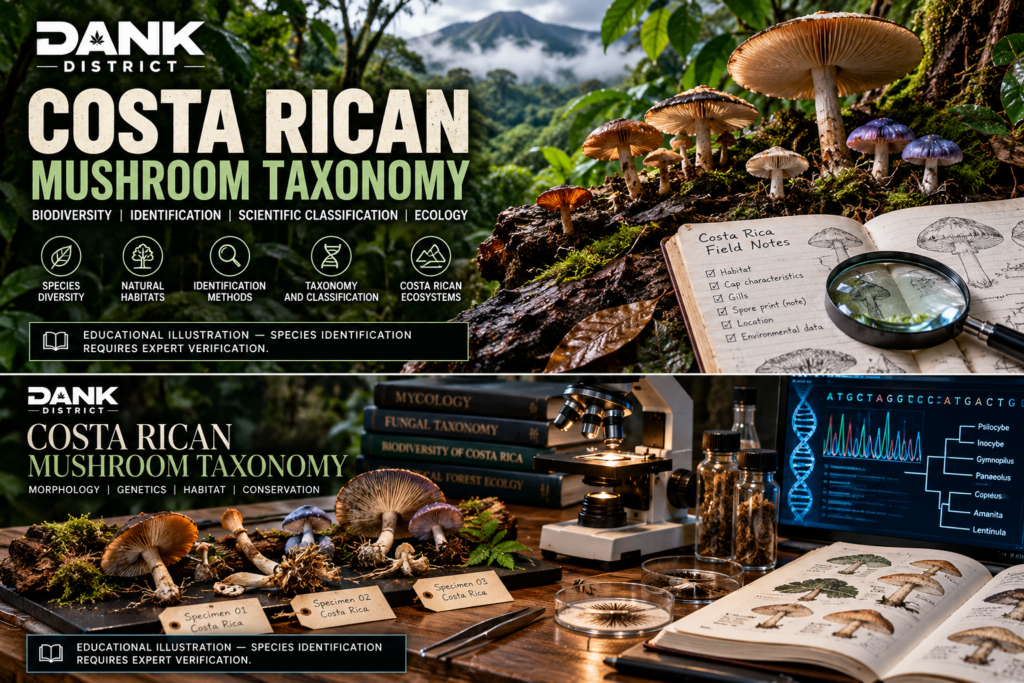
What Is Costa Rican Mushroom Taxonomy?
Taxonomy is the scientific discipline concerned with identifying, naming and classifying organisms. In mycology, the study of fungi, taxonomy provides a consistent framework for distinguishing species and understanding their relationships.
Costa Rican Mushroom Taxonomy applies these principles to fungi recorded in Costa Rica. It includes the classification of familiar mushrooms, less conspicuous woodland fungi and many organisms that do not resemble the mushrooms people typically recognise.
A mushroom is generally the visible reproductive structure of a fungus. Much of the organism may exist as microscopic threads called hyphae, which form a network known as mycelium. This network can grow through soil, leaf litter, decaying wood and other substrates.
The visible mushroom is therefore only one part of a larger biological system. A complete scientific description may consider its physical structure, microscopic features, habitat, seasonality and genetic relationships.
Taxonomy also changes as new evidence becomes available. Researchers may discover that specimens once considered the same species belong to different lineages, or that names previously treated as separate refer to the same species. Reliable classification must accommodate these revisions.
Costa Rica’s Fungal Biodiversity
Tropical forests and diverse habitats
Costa Rica is recognised for its biological diversity, and fungi are an essential component of its ecosystems. Differences in elevation, temperature, rainfall, vegetation and soil conditions create a variety of environments in which fungal communities develop.
Humid lowland forests can support fungi associated with fallen leaves, branches and decomposing wood. Cloud forests provide cool, moisture-rich conditions that favour other fungal communities. Montane environments and disturbed landscapes introduce additional ecological variation.
These habitat differences matter when researchers document fungal diversity. A species recorded in one environment should not automatically be assumed to occur throughout the country. Distribution records need evidence of the location, habitat and identity of the collected or observed organism.
Why the known species count keeps changing
A published species checklist is a snapshot of scientific knowledge, not necessarily a complete inventory of all fungi present in a country.
Some fungi are rarely observed because their visible structures appear only under particular environmental conditions. Others are difficult to distinguish without microscopy or genetic analysis. Some specimens remain unidentified because researchers lack sufficient material or comparative reference data.
The 2024 annotated checklist of Costa Rican fungi was developed through extensive literature review and collaboration among mycological researchers. Its authors compiled records, accepted names, synonyms and references, creating a resource for future identification and biodiversity research.
Research published in 2026 has also examined digitised fungal collections from Costa Rica, demonstrating how preserved specimens can improve knowledge of species diversity, geographical distribution and seasonal patterns. Explore the study, Exploring Costa Rica’s fungal trends.
How Scientists Identify Mushroom Species
1. Macroscopic morphology
Macroscopic morphology describes features visible without a microscope. Researchers may document cap shape, surface texture, gill attachment, stem structure, colour, changes during ageing and the form of the fruiting body.
These characteristics are useful for narrowing down possible identifications. However, they can vary with age, moisture, environmental conditions and damage. Unrelated species may also develop similar appearances.
For these reasons, a visual resemblance is not a definitive identification. A photograph may provide useful supporting evidence, but it often omits important details needed for a reliable taxonomic conclusion.
2. Microscopic characteristics
Microscopy reveals features that cannot be assessed reliably with the naked eye. Depending on the group, specialists may examine spore dimensions and shape, surface ornamentation, cystidia, hyphal structures and the arrangement of tissues.
These features can help separate closely related taxa that appear similar in photographs. Their value depends on accurate measurement, suitable preparation and comparison with published descriptions or authenticated specimens.
Taxonomic research often combines several characters rather than relying on one feature. A single observation rarely establishes a species identity in isolation.
3. DNA sequencing and phylogenetics
Molecular methods have transformed modern fungal taxonomy. DNA sequences can help researchers assess relationships between specimens, compare populations and investigate whether apparently similar fungi represent distinct evolutionary lineages.
A 2024 study of the genus Psilocybe used genome-scale data from preserved fungal collections to refine its evolutionary relationships. The research also examined the history of genes associated with psilocybin biosynthesis. Read the peer-reviewed study, Phylogenomics of the psychoactive mushroom genus Psilocybe.
This research concerns the evolutionary history of a fungal genus; it does not establish that any particular species occurs in Costa Rica. Geographic claims still require appropriate specimen or observation records.
DNA evidence also has limitations. Results depend on sample quality, reference sequences, analytical methods and how well the relevant group has been studied. Molecular results are strongest when interpreted alongside morphology, collection data and established taxonomic literature.

Understanding Scientific Names and Classification
Scientific names provide a shared language for researchers working across countries and institutions. A species name normally consists of a genus followed by a specific epithet. The name is connected to a formal description and the rules governing botanical and fungal nomenclature.
Synonyms can arise when the same species has been described under different names or when taxonomic interpretations change. An annotated checklist records these relationships so that older research can be connected with current classifications.
This is especially important when examining older records. A historical publication may use a name that is no longer accepted, or an identification may have been based on features that later research showed were insufficient.
Costa Rican Mushroom Taxonomy therefore depends on more than collecting names from websites. Researchers need to consult authoritative taxonomic literature, verify synonymy and determine whether records refer to the same biological species.
What About Psilocybe and Other Fungi?
The genus Psilocybe is one example of a fungal group that has received significant attention in taxonomy and evolutionary research. However, it is only one part of the wider fungal kingdom, and it should not be used as a synonym for all mushrooms.
Scientific reviews have examined the taxonomy, phylogenetics and ecology of several genera associated with psychoactive compounds, including Psilocybe, Panaeolus, Pluteus and Gymnopilus. The review An Overview on the Taxonomy, Phylogenetics and Ecology of the Psychedelic Genera explains why these groups need to be distinguished scientifically.
A genus-level reference does not prove the occurrence of every member of that genus in a particular country. Nor does a mushroom’s appearance establish whether it contains a specific compound.
For Costa Rican Mushroom Taxonomy, species distribution should be supported by reliable records, authenticated specimens or appropriate scientific publications. Claims based only on online photographs or informal reports should be treated cautiously.
For related educational reading, DANK DISTRICT also maintains separate references on Costa Rican mushroom taxonomy, B Mushroom Mycology Reference, Blue Meanie Mycology Reference and Cambodian Strain Mycology Reference. These pages should be read as separate topics, not as proof of species identity or geographic origin.
Why Fungal Collections and Herbarium Records Matter
A preserved specimen can provide lasting evidence for a scientific observation. Fungal collections, often maintained by herbaria and research institutions, allow future researchers to revisit earlier identifications using improved methods.
Collection records may include the date, location, habitat, collector, identifying researcher and specimen identifier. These details help establish where and when a fungus was documented.
Preserved material is particularly valuable when classification changes. A specimen collected decades ago may be re-examined with modern microscopy or DNA sequencing, potentially correcting an earlier identification or revealing an overlooked species.
Digital collection databases make this information more accessible to researchers around the world. Nevertheless, digitisation does not remove every limitation: older records may contain incomplete location data, outdated names or uneven sampling across habitats.
Costa Rican Mushroom Taxonomy benefits when collections are carefully curated and researchers document uncertainty rather than forcing an identification beyond what the evidence supports.
Fungi, Forest Ecology and Conservation
Fungi contribute to ecosystem processes in several ways. Many are decomposers that break down dead plant material, returning nutrients to the environment. Others form mycorrhizal associations with plant roots, helping exchange nutrients and water. Some fungi interact with insects, other fungi and living plants in more complex ecological relationships.
Because fungal communities respond to environmental conditions, their distribution can provide useful information for biodiversity studies. Researchers may examine whether records differ between habitat types, elevation zones, seasons or areas experiencing environmental change.
However, reliable ecological conclusions require well-documented data. A concentration of records in one region may reflect greater research activity rather than genuinely higher fungal diversity. Researchers must consider collection effort, accessibility and sampling bias.
Protecting forest habitats also helps preserve the ecological relationships that support fungal communities. Responsible field research should minimise disturbance, follow local collection rules and respect protected areas.
Common Mistakes in Mushroom Identification
Several errors can undermine fungal identification and the interpretation of taxonomic information.
Relying on colour alone. Colour can change as a mushroom ages, dries or becomes damaged. Similar colours occur across unrelated groups.
Treating location as proof. A fungus recorded in one country or habitat is not automatically present at every nearby location.
Confusing common names with scientific names. Common names can refer to multiple organisms, while scientific names may change as classification improves.
Assuming that a photograph is enough. Important microscopic characteristics and collection details may be missing from an image.
Ignoring updated research. Older names and identifications may need revision after new morphological or molecular evidence becomes available.
Assuming taxonomy establishes safety. Correctly identifying a fungus does not, by itself, establish that it is safe to eat or handle. This article is not a guide to foraging or consumption.
Frequently Asked Questions
What is Costa Rican Mushroom Taxonomy?
Costa Rican Mushroom Taxonomy is the scientific identification, naming and classification of fungi documented in Costa Rica. It draws on morphology, microscopy, molecular evidence, specimen collections and published research.
How many fungal species are documented in Costa Rica?
A comprehensive annotated checklist published in 2024 reported 5,676 species and subspecific taxa based on the literature it reviewed. Later research has expanded the available records, so the number should be understood in the context of the dataset and publication date.
Can researchers identify a mushroom from a photograph?
Photographs can help document visible features, but they do not always provide enough evidence for a definitive species identification. Microscopy, specimen records and DNA analysis may be needed.
Why is DNA important in fungal taxonomy?
DNA sequencing helps researchers investigate evolutionary relationships and distinguish lineages that may be difficult to separate using appearance alone. Its results must be interpreted with reliable reference data and other evidence.
Does a Costa Rican species record prove that a mushroom is native to the country?
Not by itself. Researchers must assess the quality of the record, the specimen identification and the evidence for geographic occurrence. A record also needs to be interpreted in context before making claims about native status or distribution.
Are all mushrooms in the genus Psilocybe the same?
No. The genus contains multiple species with different characteristics and distributions. Research on one species should not automatically be applied to every other member of the genus.
Why do scientific mushroom names change?
Names and classifications can change when researchers revise historical descriptions, discover synonyms or obtain new morphological and genetic evidence. Taxonomic updates help scientific records reflect the best available evidence.
Conclusion: The Importance of Costa Rican Mushroom Taxonomy
Costa Rican Mushroom Taxonomy provides a framework for understanding fungal biodiversity, species relationships and the ecological importance of fungi across Costa Rica’s varied landscapes. It brings together field observations, microscopy, molecular research, preserved specimens and carefully documented scientific literature.
The country’s annotated fungal checklist and ongoing studies demonstrate that biodiversity inventories are continually developing. New records, revised identifications and improved DNA methods can all change what researchers know about fungal diversity and distribution.
A reliable approach to Costa Rican Mushroom Taxonomy avoids unsupported species claims and recognises that a photograph, common name or geographical suggestion cannot replace scientific verification. Strong identification depends on evidence that can be checked and interpreted by other researchers.
For readers exploring mycology, the best starting points are peer-reviewed studies, curated fungal collections and authoritative taxonomic databases. These resources help separate established findings from speculation and provide a stronger foundation for understanding fungi.
Explore the related DANK DISTRICT educational references linked in this article to continue reading about fungal classification and research. Each subject should be considered individually, with scientific evidence and conservation awareness at the centre of the discussion.
Editorial disclaimer: This article is for educational purposes. It does not identify a particular mushroom specimen, establish the presence of a species in Costa Rica, or provide advice on foraging, cultivation or consumption.